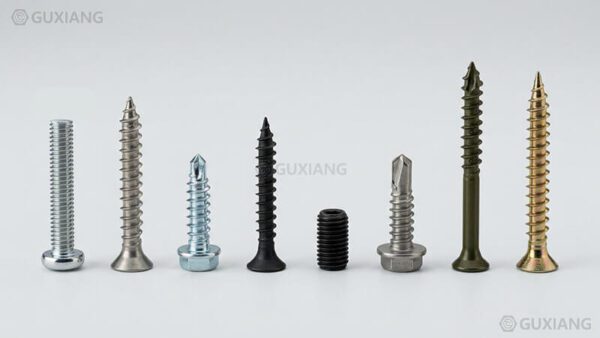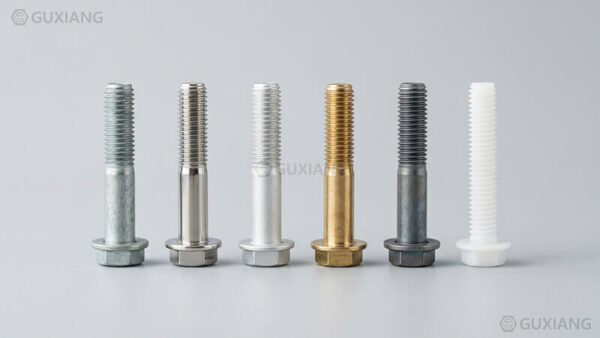






A screw is an externally threaded fastener that holds parts together by cutting or forming its own mating thread as it is driven. That is the short answer to what is a screw: it makes the joint from the head side, where a bolt instead passes through a clearance hole and is tightened with a nut. The difference looks small on paper and decides everything about how you specify, install, and service the part, which is why the two words get used loosely even though standards treat them as separate products. This guide defines what a screw is, maps the main screw types, drives, and threads, and gives you a selection framework you can apply straight to a drawing.
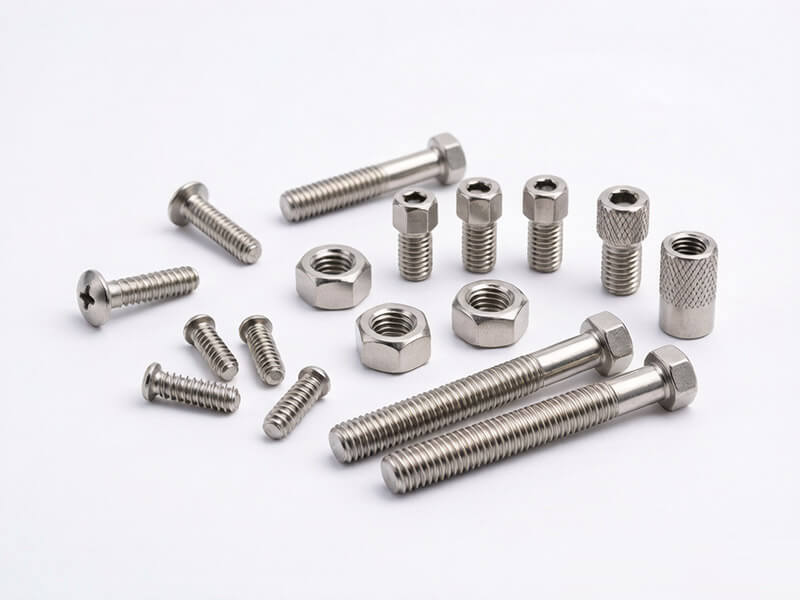
What Is a Screw?
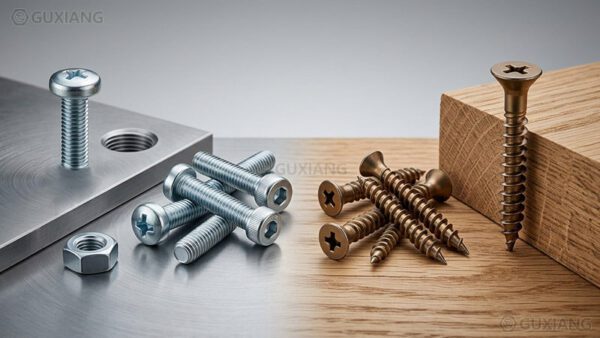
A screw is any externally threaded fastener driven by its head to engage a thread in one of the parts being joined, or to form that thread as it goes in. The definition splits into two install methods that matter in practice. A machine screw runs into a pre tapped hole or a nut of matching size and pitch. A self tapping or self drilling screw cuts or rolls its own thread in sheet metal, plastic, or wood, so it removes a separate tapping operation. Both leave the same clamping force behind, but they change the substrate you can join and the tooling you need.
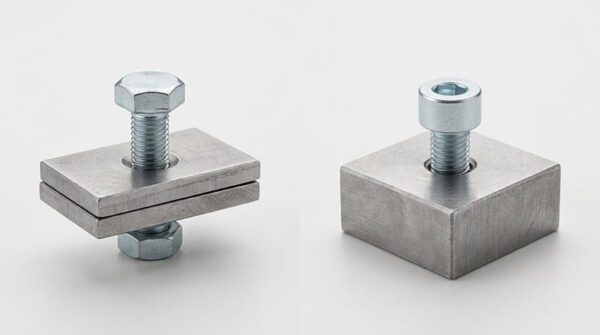
The clean way to tell a screw from a bolt is who tightens it. A bolted joint is tightened from the nut side with the shank passing through both parts; a screwed joint is tightened from the head side into a thread that is already there or is created on the way. A nail is different again: it holds by friction and deformation, not by a thread, so it carries almost no tension and pulls out far more easily. The full fastener family is set out in our what is a fastener guide, and our screw range organises the products by head, drive, and material.
Five attributes decide which screw fits a drawing. Head style sets how the part seats and how torque reaches it. Drive sets how much torque the recess accepts before the tool cams out. Thread sets what it mates with and whether it forms its own. Material sets how long it survives the environment. Application sets which standard and convention govern it. Name all five and the part is specified; miss one and the order comes back.
How Does a Screw Work?
A screw in a threaded hole works the same way a bolt does: tightening stretches the screw elastically, that stretch is preload, and the resulting compression on the joint faces is clamp load. The plates are then held by friction between their faces, and the screw only sees shear if that friction is overcome. This is why a loose screw breaks, and why a torque figure quoted without a friction condition is not a specification. On a screw the thread form behind that stretch is described at Wikipedia’s screw thread entry.
Self tapping and self drilling screws add a second mechanism. Instead of running into an existing thread, they cut or roll their own as they advance, so the screw is the tool and the fastener at once. A self drilling point even drills its own clearance hole first, which is why it is used where drilling a pilot would stop a production line. The trade is stricter control of the substrate: too hard and the point dulls, too soft and the thread strips before the head seats.
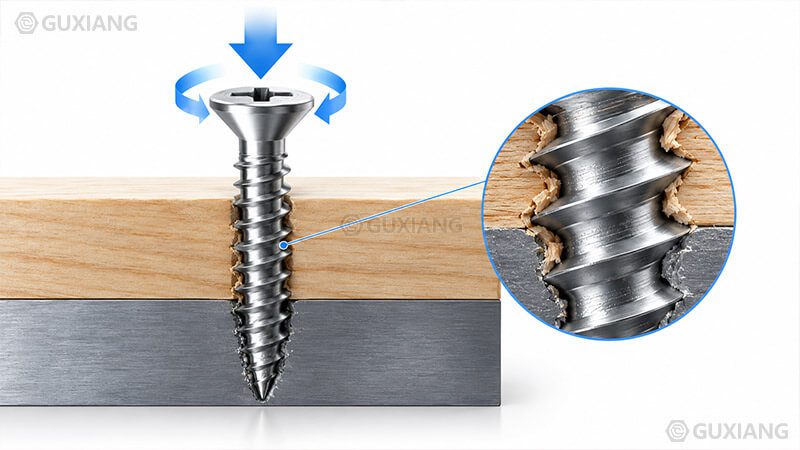
Thread engagement quietly sets whether the joint holds. A working rule for a steel screw into steel is engagement around one times the diameter, rising to about 1.5 times for aluminium and two times or more for plastics. Below that, the thread strips before the screw reaches proof load, which on the bench looks like a screw quality problem but is really a hole depth problem. Loosening from vibration lets the screw rotate back a fraction each cycle, so prevailing torque threads, serrated washers, or thread locking compounds appear in vibration prone assemblies, and correct preload matters more than any locking device.
One practical trap is treating torque as the goal rather than the means. A torque wrench sets an input, but the output that matters is the stretch in the screw and the clamp it creates, and that output swings with lubrication, plating, and surface finish. The same torque on a dry plain screw and a waxed plated screw can land at very different preload, which is why critical joints quote torque with a friction condition or use a tension controlled method. When the joint is safety related, verify preload directly rather than trusting the wrench alone, and put the friction condition on the drawing so the assembler and the inspector read the same number.
The joint fails in two distinct ways once preload is set. If service tension stays below the clamp load, the interface stays closed and the screw sees no load from the joint, which is the condition good design aims for. If service tension rises above preload, the plates separate and the screw then carries the full external load as tension on its own, which is the fast path to fatigue failure. Sizing with preload above the expected service tension is the engineering margin, and that is why joint stiffness and the count of fasteners matter as much as the screw grade. A soft gasket or compliant substrate lowers the stiffness and lets the joint open sooner, so the same preload holds a metal face better than a rubber faced one.
Types of Screws
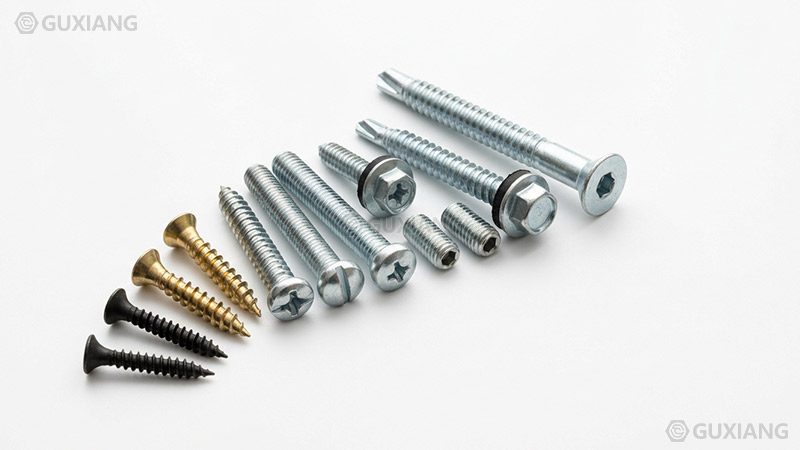
Screw types sort by what they join and how they are driven. The table compares the families buyers meet most; treat it as a map, not a spec.
| Type | How it engages | Typical substrate | Pre drilled hole | Removability |
|---|---|---|---|---|
| Machine screw | Runs into a tapped hole or nut | Metal, plastic assemblies | Tapped hole | Removable |
| Wood screw | Forms coarse thread in fibres | Timber, plywood | Pilot recommended | Removable |
| Self tapping screw | Cuts or rolls its own thread | Sheet metal, plastic | Usually a pilot | Removable |
| Sheet metal screw | Sharp thread forms in thin metal | Sheet, plate | Pilot or punch | Removable |
| Set screw | Headless, locks a hub to a shaft | Machinery collars, pulleys | Tapped hole | Removable, semi permanent |
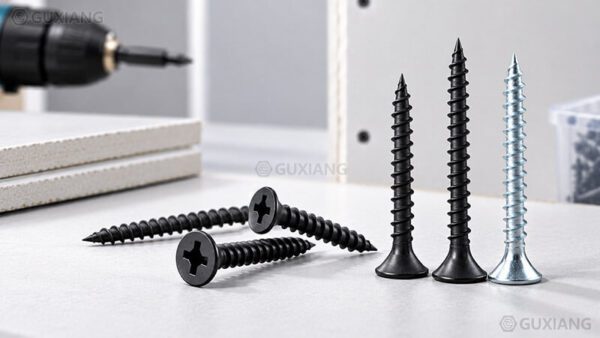
| Drywall screw | Bugle head, coarse thread | Board to stud | No | Removable |
| Deck screw | Corrosion resistant, sharp point | Treated timber outdoors | No | Removable |
| Chipboard screw | Deep thread, cuts board dust | MDF, particle board | Pilot optional | Removable |
Read the last two columns together, because they decide behaviour in service. A machine screw wants a tapped hole; a wood screw wants a pilot to stop splitting; a self tapping screw wants only a clearance or guide hole. Our machine screws, wood screws, self tapping screws, sheet metal screws, chipboard screws, and drywall versus deck screws guides cover each family in depth, because the head, point, and thread geometry differ more than the name suggests.
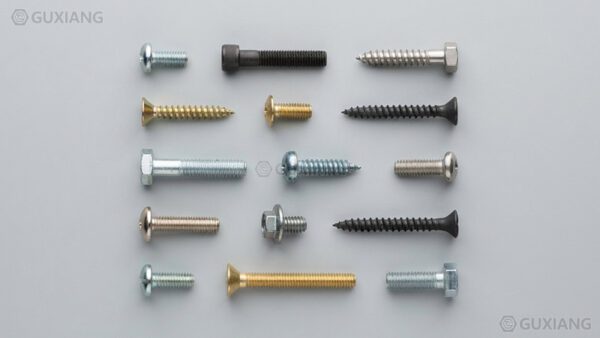
Head style is its own dimension. Hex heads take side torque from a socket, button and socket cap heads sit flush in enclosures, and countersunk heads seat flush in a countersunk hole. The full set is in our screw head types guide. Material splits the same list again, and that is covered in the materials section below.
Screw Drives and Recesses
The drive sets how much torque a screw accepts before the tool slips, and it decides whether the joint can be assembled by hand or only by machine. Slotted drives are the oldest and the easiest to damage, because a flat blade walks out under side load. Phillips drives were designed to cam out deliberately, which protects the joint at low torque but limits the preload a technician reaches by hand. Pozi adds extra ribs to reduce that cam out while staying cross compatible with Phillips drivers.
Hex and Torx transmit far more torque with less radial force, which is why Torx has taken over automotive and appliance assembly where a slipped driver wrecks the product. Square (Robertson) drives grip well and are common in wood construction. The full comparison, including the torque and cam out behaviour of each, is in our screw drive types guide, and the three way Phillips versus Torx versus flat head comparison shows where each wins on the line. Pick the drive from the assembly method, not the catalogue picture, because a drive the tooling cannot seat is a screw that never reaches preload.
Screw Threads
A screw thread is the helix that converts rotation into clamp load, and its geometry fixes what the screw mates with. Metric screws use a nominal diameter in millimetres and a pitch in millimetres, such as M4 x 0.7, while inch series screws use a fractional diameter and threads per inch, such as 8-32 UNC. The two are not interchangeable even at similar diameters, because the pitch and in some cases the thread angle differ. Full dimension tables are in our metric thread chart and imperial thread chart, and pitch detail is in our thread pitch chart.
Coarse versus fine pitch is the first choice after diameter. A coarse pitch gives more thread engagement per turn, resists cross threading, and is the default for general assembly and wood. A fine pitch takes up less length for the same tension and holds better under vibration, which is why thin sections and adjustment screws use it. Self tapping screws use dedicated forms: a standard machine like thread for thin metal, a wider spaced thread for wood and board, and hi lo or spaced forms that cut their own path in plastic. State the system and pitch on the drawing, because a fine pitch nut will start on a coarse screw and then seize a few turns down.
A thread is specified by more than diameter and pitch. The lead, or advance per turn, sets how far the screw moves with each rotation, and the engagement length sets whether the thread strips before the screw reaches proof load. A short screw into a thick soft part strips in the substrate, not in the fastener, which is why thin materials get coarser threads and longer engagement. Crest and root form also matter: a rounded root resists fatigue better than a sharp one, and a flat crest sheds debris in dirty service. Confirm the thread form and engagement against the same standard that sets the diameter, because mixing a fine pitch nut onto a coarse screw fails a few turns in.

Screw Materials
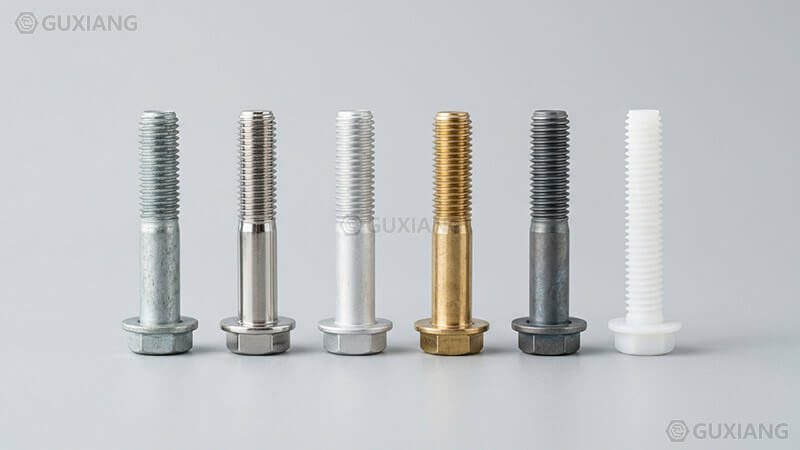
Material selection sets corrosion behaviour, weight, temperature limit, and unit cost in one decision. The table compares the seven families most buyers meet; treat the figures as indicative, and confirm against the governing grade standard before specification. Each family has a dedicated guide in our fastener materials comparison.
| Material family | Typical grades | Tensile strength (indicative) | Corrosion resistance | Cost index (carbon = 1.0) |
|---|---|---|---|---|
| Carbon steel | 4.8, 5.8, 8.8 | 400–800 MPa | Poor, needs a coating | 1.0 |
| Alloy steel | 10.9, 12.9, ASTM A193 B7 | 1000–1200 MPa | Poor, needs a coating | 1.3 |
| Stainless steel | A2-70 (304), A4-70 (316), A4-80 | 500–800 MPa | Good to excellent | 3.0–4.0 |
| Brass | C36000, CZ121 | 300–500 MPa | Good, not in chlorides | 3.0 |
| Aluminium | 6061-T6, 7075-T6 | 310–570 MPa | Good, from the oxide film | 2.5 |
| Titanium | Grade 2, Grade 5 (Ti-6Al-4V) | 340–1100 MPa | Excellent, including seawater | 10 and above |
| Plastic (nylon, PEEK) | PA66, PEEK, PVDF | 50–90 MPa | Excellent | High per kilogram, low per part |
Carbon steel is where most screws start, because it delivers the best strength for the money and the widest range of head and drive options. Its weakness is corrosion, so almost every outdoor screw is supplied with a coating, from zinc plate to galvanizing. See our carbon steel fasteners guide.
Alloy steel pushes strength higher for fixed joint size, reaching property classes 10.9 and 12.9, but it corrodes like carbon steel and needs hydrogen relief after plating. See our alloy steel fasteners guide.
Stainless resists corrosion through a chromium rich passive film that reforms when damaged, so it needs no coating in many wet environments. The two families buyers meet most are 304 (A2) and 316 (A4), which adds molybdenum for chloride resistance; grades are set out in our stainless steel fastener grades guide.
Brass serves decorative and electrical roles and machines beautifully, but it is soft beside steel and suffers in chloride service. Aluminium carries roughly one third the density of steel for transport and aerospace enclosures. Titanium offers outstanding strength to weight and seawater resistance at an order of magnitude above steel cost. Engineered plastics such as nylon and PEEK produce non conductive, non magnetic parts for electrical and corrosive duty, covered in our nylon and PEEK fasteners guide.
One rule overrides the rest on mixed metal assemblies: do not couple metals far apart on the galvanic series without isolation. A small aluminium bracket on a large stainless panel is the classic failure, because the aluminium becomes the anode. The mechanism is set out at Wikipedia’s galvanic corrosion entry.
Screw Standards
Standards exist so a callout on a drawing means the same thing to a mill in one country and an assembly plant in another. In practice a screw specification cites a dimensional standard that fixes the thread and head geometry, and a material or property standard that fixes the strength. A metric machine screw cites ISO 261 for the thread and ISO 4759 for tolerances; an inch screw cites ASME B1.1 for the thread form and ASME B18.6 for the head dimensions.
The systems overlap more than newcomers expect, and that is where substitution mistakes happen. Metric and inch series are not interchangeable at all, because the thread angle and pitch differ even at similar diameters. Name one system per drawing. The bodies that publish them maintain the most durable links: start with ISO for international metric work, ASME for inch series dimensions and thread form, SAE International for automotive grades, and ASTM International for material and coating specifications. For how the DIN, ISO, ANSI, and ASME systems relate on a global project, see our fastener standards explained guide.
Screw Dimensions and Sizes
A screw callout is four numbers in the right order: nominal diameter, thread pitch, length, and the standard that fixes the head and thread. “M4 x 0.7 x 16 ISO 261” is unambiguous; “M4 x 16” is not, because M4 also comes in a coarse and a fine pitch, and a fine pitch nut will start on a coarse screw and seize a few turns down. Length convention matters too: a countersunk screw length includes the head, while a pan or hex head screw length stops at the underside of the head, so a 16 mm pan screw and a 16 mm countersunk screw are not the same installed length.
| Metric designation | Nominal diameter (mm) | Standard coarse pitch (mm) | Typical use |
|---|---|---|---|
| M2 | 2.0 | 0.4 | Small electronics, terminals |
| M3 | 3.0 | 0.5 | Electronics, light assemblies |
| M4 | 4.0 | 0.7 | General machinery, enclosures |
| M5 | 5.0 | 0.8 | Frames, brackets |
| M6 | 6.0 | 1.0 | Structural, fixtures |
| M8 | 8.0 | 1.25 | Heavy fixtures, mounts |
Common ISO metric coarse series for machine and tapping screws. Fine pitch and inch series differ; confirm against the dimensional standard.
Inch screws use a different vocabulary: a numbered or fractional diameter and threads per inch. A 6-32 machine screw and an M3.5 screw are close in diameter but not interchangeable, because the pitch and thread angle differ. Convert deliberately and check the thread form, not only the diameter. Full listings are in our metric thread chart and imperial thread chart.
How to Choose a Screw
Selection is a sequence, not a single decision. Work the steps in order, because each one narrows the options for the next.
Define the joint. What is being joined, how thick is the stack, and can you drive from the head side? One sided access pushes you toward self tapping or self drilling screws.
Quantify the load. Tension, shear, or a mix; static or cyclic? Cyclic loading makes clamp load retention the priority.
Set the environment. Indoor dry, rain washed, coastal salt, or chemical each narrows the material and coating pair.
Pick the material and grade. Material for the environment, grade for the load. Our bolt grade chart sets the strength classes side by side.
Choose the drive. Match it to the assembly method and the torque the joint needs; Torx for machine driving, Phillips for hand assembly.
Fix the thread and dimensions. Name the system, diameter, pitch, and length, in that order.
Check coating, assembly, and cost. Tool clearance, automation, and total installed cost rather than unit price.
The table below compresses that sequence for the service conditions we see most often.
| Service condition | Recommended type | Recommended material | Recommended coating or finish |
|---|---|---|---|
| Dry indoor, light load | Machine screw | Carbon steel 4.8 / 5.8 | Zinc plate, Fe/Zn 5–8 |
| Wood framing or furniture | Wood screw | Carbon steel or stainless | Zinc plate or passivation |
| Sheet metal enclosure | Self tapping or sheet metal screw | Carbon steel 8.8 | Zinc plate, Fe/Zn 8–12 |
| Outdoor, rain exposure | Deck or structural screw | Carbon steel 8.8 | Hot dip galvanized or Fe/Zn 25 |
| Coastal air or de icing salt | Marine screw | Stainless A4-70 (316) | Passivation |
| Electrical isolation | Nylon or PEEK screw | PA66 or PEEK | None |
| Thin board, blind access | Chipboard or self tapping screw | Hardened steel | Zinc plate or black oxide |
Indicative recommendations. Confirm against the governing design code and the actual service environment.
Two habits separate a good specification from an average one. Write the environment on the drawing alongside the part callout, and treat unit price as the last filter: a screw that costs three times more but removes a warranty claim is usually cheaper. For coating selection see our zinc plating guide and our galvanized versus zinc plated comparison.
Three mistakes appear repeatedly in rejected specifications. The first is rating the joint by diameter alone and ignoring engagement length, which lets the thread strip before the screw reaches proof load. The second is specifying a coating after the threads are cut, so the plating consumes the fit and the nut jams; decide the coating before the thread is rolled. The third is mixing systems on one drawing, such as a metric screw with an inch tapped hole, which looks close on paper and fails on the bench. A short checklist on the drawing, diameter, pitch, grade, coating, and standard named in that order, prevents most of these before the first part is made.
Applications of Screws
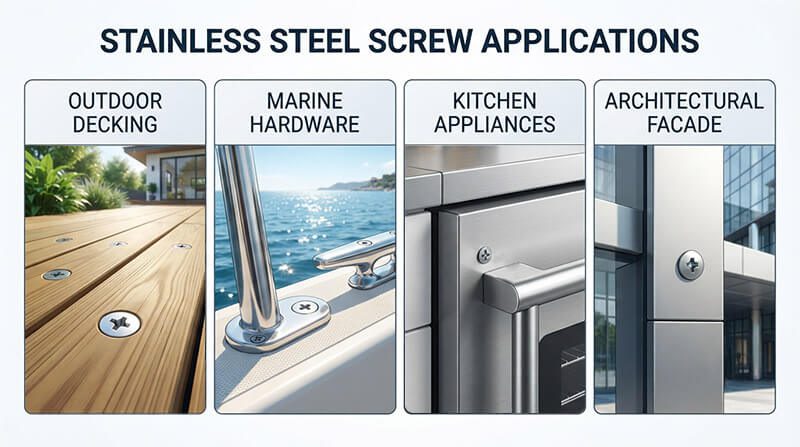
Screw applications group by the demands each sector places on the joint. Woodworking and furniture use coarse wood screws and chipboard screws, where the thread form grips fibres without splitting; a pilot hole is the difference between a clean joint and a cracked rail. Construction and decking use corrosion resistant screws with aggressive points that drive into treated timber, and the coating decides service life more than the base metal.
Automotive and appliance assembly is high volume and automated, which is why Torx drives and prevailing torque threads dominate, and why zinc flake coatings carry no hydrogen risk. Electronics and electrical enclosures push toward small machine screws into pressed or self clinching nuts, with plastic screws where isolation is needed; torque values are low and the failure mode is a stripped thread. Marine and coastal work makes material the priority, so A4-70 (316) stainless or a heavy coating on carbon steel is the starting point, and dissimilar metal contact is designed out. The broader fastener family behind these choices is set out at Wikipedia’s fastener entry.
The cheapest screw is rarely the cheapest joint. A plain zinc plated screw that fails in coastal service takes the whole assembly back to the bench, while a stainless or heavily coated screw that survives costs more once and stays. The same logic favours the right drive for automated lines, because a Torx that never cams out removes rework and stripped heads. Specifying for the real environment, not the catalogue price, is what separates a joint that ships once from a joint that comes back under warranty.
Renewable and structural work adds its own constraints. Solar racking and façade systems sit outdoors for decades, so the coating and the dissimilar metal plan decide whether the array still clamps after a storm season, and the screw is selected for twenty year weather exposure rather than catalogue price. In these jobs the screw is part of the structure rather than just a holder, so the grade, coating, and inspection records are treated like any other structural element. Transport and energy buyers reach for the same discipline: a fastener that outlives the warranty is cheaper than a fastener that does not.
How Screws Are Manufactured
Most small screws start as wire rod and are formed by cold heading: the wire is cut to length and upset in a multi station machine that forces metal into a die, forming the head without cutting. Cold heading is fast, produces almost no scrap, and work hardens the material. Critically it leaves the grain flow following the shape of the part rather than cut across it, which is why a cold headed screw is stronger in the head to shank fillet than the same part machined from bar. Machining is reserved for large diameters, low volumes, and special geometries, because it wastes material and interrupts grain flow where fatigue cracks start.
Threads are formed by rolling rather than cutting on almost all production screws. Two dies press the thread form into the blank, displacing metal instead of removing it. Rolled threads are stronger for two reasons: the surface is burnished and work hardened, and the grain flow follows the profile. Self tapping and self drilling screws add a point and a thread form that cuts or rolls its own mating path, so they remove a tapping operation on the line.
Heat treatment comes next for anything above the lowest property classes. Carbon and alloy steel screws are quenched and tempered to reach the specified strength, and the tempering temperature sets the balance between hardness and ductility. This step makes an 8.8 screw an 8.8 screw, and it also puts hydrogen embrittlement on the risk list, because a hard part is a susceptible part. Acid pickling and electroplating can drive hydrogen into the steel, so a hydrogen relief bake is applied soon after plating, commonly within four hours, at roughly 190–220 °C for a minimum of three hours. Above about 1000 MPa tensile or 39 HRC the bake is not optional; above 1200 MPa many specifications forbid electroplating and require a process with no acid step, such as mechanical galvanizing or zinc flake. Both thresholds are laid out in ASTM B633-23.

Surface treatment follows, then inspection. Thread inspection uses go/no-go gauges: the go gauge must run the full thread under finger torque, and the no-go gauge must not enter beyond the permitted amount. On a coated part the go gauge is the check that matters, because a plating of 5–25 µm can consume a large share of the 6g/6H tolerance and make a nut that ran freely before plating bind after it, which is why the thread is cut or rolled after coating on tight tolerances. Stainless takes a different route, where passivation rebuilds the chromium oxide film, described at Wikipedia’s passivation entry. Where we add value is treating these as one connected process, the subject of our engineering driven fastener solutions page.
Volume production holds the tolerances that matter through the tooling rather than through inspection. The cold heading die and the thread rolling dies set the geometry part to part, so a run of a million screws stays inside the window set by the gauges, and the inspector samples rather than measures every piece. Secondary operations such as drilling a hole, milling a slot, or pointing a reduced shank are added after forming when a customer needs a special feature, and each one is placed away from the fillet where fatigue starts. The same part made by machining from bar would need full inspection and still carry the weaker grain structure.
Custom Screw Options
Catalog screws cover most requirements, and the economics of cold heading mean a standard part is almost always cheaper. There are four situations where a custom screw is worth it, and in each the tooling cost is recovered elsewhere: a geometry the catalog does not offer, such as a non standard length, shoulder, or combined head and thread form; a material or grade combination the environment demands; a coating or lubrication specification that must hit a salt spray or friction target; and consolidation, where one part replaces two or three.
Custom work changes the commercial shape of the order. Tooling is a fixed cost, so unit price falls steeply with volume and there is a minimum quantity below which machining is the better route. Lead time includes tooling manufacture and first article approval, which belongs in the project schedule. First article inspection should be agreed before production, with the acceptance gauges named in writing. The deliverable that matters most is a drawing the manufacturer can read without guessing: every dimension affecting fit, the standard, material and grade, coating and thickness, and inspection method. Our custom fastener services team works from that level of definition.
Need a specific screw size, material, standard or custom geometry? Send the drawing and the service environment to our engineering team and we will confirm the specification, the tooling route, and a realistic lead time.
Need a specific screw size, material, standard or custom geometry?
Send the drawing and the service environment to our engineering team and we will confirm the specification, the tooling route, and a realistic lead time.
FAQ
What is the difference between a screw and a bolt?
A: A screw is driven by its head to engage a thread in one of the parts or to form that thread as it goes in, while a bolt passes through a clearance hole and is tightened with a nut from the opposite side. The distinction is about how it is installed rather than how it looks, which is why the same externally threaded part can be called either depending on the joint. In practice a screwed joint is tightened from the head side and a bolted joint from the nut side, and both create the same clamping force.
What are the main types of screws?
A: The main groups are machine screws that run into a tapped hole or nut, wood and chipboard screws that form a coarse thread in fibres, self tapping and sheet metal screws that cut or roll their own thread in metal or plastic, and set screws that lock a hub to a shaft. Within each group the classification runs by head style, drive type, thread form, material, and application. Most assemblies use one of these with a washer to spread the load.
What is the difference between self tapping and self drilling screws?
A: A self tapping screw cuts or rolls its own mating thread as it is driven but still needs a pilot or clearance hole to start. A self drilling screw has a drill point that makes its own hole first, so it needs no separate drilling operation and is used where stopping the line to drill would cost time. Both remove a tapping step; the self drilling version also removes the drilling step. Pick by whether the substrate can be pre drilled economically.
What does a screw drive type do?
A: The drive sets how much torque the recess accepts before the tool slips out, and it decides whether the joint can be assembled by hand or only by machine. Slotted and Phillips cams out at low torque and protect the joint but limit preload; Torx and hex transmit far more torque with less radial force and dominate automated assembly. Choose the drive from the assembly method, because a drive the tooling cannot seat never reaches preload.
What is the difference between coarse and fine thread?
A: Coarse thread gives more engagement per turn, resists cross threading, and is the default for general assembly and wood. Fine thread takes up less length for the same tension and holds better under vibration, which is why thin sections and adjustment screws use it. The two are not interchangeable, because a fine pitch nut will start on a coarse screw and then seize. State the pitch on the drawing so the mating part is unambiguous.
What screw should I use for wood?
A: Use a wood screw with a coarse thread and a large root radius that grips fibres without splitting, and drill a pilot hole in hardwood or near an edge to avoid cracking. Chipboard and MDF need a deep threaded chipboard screw that cuts its own path in the board. Match the coating to the environment: plain zinc plate indoors, a corrosion resistant finish outdoors. Do not substitute a machine screw, because its fine thread will strip in wood.
What screw should I use outdoors?
A: For outdoor and coastal service use a stainless A4-70 (316) screw with passivation, or a carbon steel screw with a heavy coating such as hot dip galvanizing or Fe/Zn 25 zinc plate. Plain zinc plate fails quickly in chloride exposure, so specify the coating for the environment rather than the base metal alone. Keep dissimilar metals apart to avoid galvanic attack on the more anodic part.
How do I stop a screw from camming out?
A: Cam out is the tool slipping out of the recess under load, and it damages both the screw and the surface. Use a Torx or hex drive instead of slotted or Phillips where torque is high, because they transmit more torque with less radial force. Seat the driver fully, hold it square to the head, and drive at the correct speed. For vibration service add a prevailing torque feature or a thread locking compound so the screw cannot rotate back.
What does a screw property class mean?
A: On metric carbon steel screws the property class is a code such as 4.8 or 8.8, where the first number times 100 gives the minimum tensile strength in MPa and the second number times 10 gives the yield to tensile ratio. So an 8.8 screw has a minimum tensile strength of 800 MPa and yields at 80 percent of that. Inch series uses SAE grades such as 2, 5, and 8, and stainless uses A2-70 or A4-70, where 70 means 700 MPa tensile.
Can I use a metric screw in an imperial threaded hole?
A: No. Metric and inch threads differ in pitch and, for some forms, in thread angle, so a metric screw will not run a full turn in an imperial tapped hole and will cross thread or seize. Even at a similar diameter the fastener is not interchangeable, and the required tools and washers differ. Name one system per drawing, and confirm the thread form before substituting across systems.
References
Fastener, Wikipedia. Background on the fastener family, the screw and bolt split, and the scope of the term used in this guide.
Screw thread, Wikipedia. Reference for thread geometry, pitch, and the mechanics behind preload generation.
ISO. The international body behind ISO 261 (thread) and ISO 4759 (tolerance) cited in the thread and standards sections.
ASTM International. Source of material and coating specifications referenced across the materials and manufacturing sections.
ASTM B633-23, Electrodeposited Coatings of Zinc on Iron and Steel. The current revision setting zinc plating thickness classes and hydrogen relief baking requirements.
ASME. Publisher of the ASME B1.1 thread form and B18.6 screw head dimensions for inch series fasteners.
SAE International. Source of SAE grades for carbon and alloy steel fasteners.
Galvanic corrosion, Wikipedia. Background on dissimilar metal attack and the galvanic series used in the materials section.
Passivation (chemistry), Wikipedia. Reference for the passive film behind stainless corrosion resistance and the passivation treatment.