





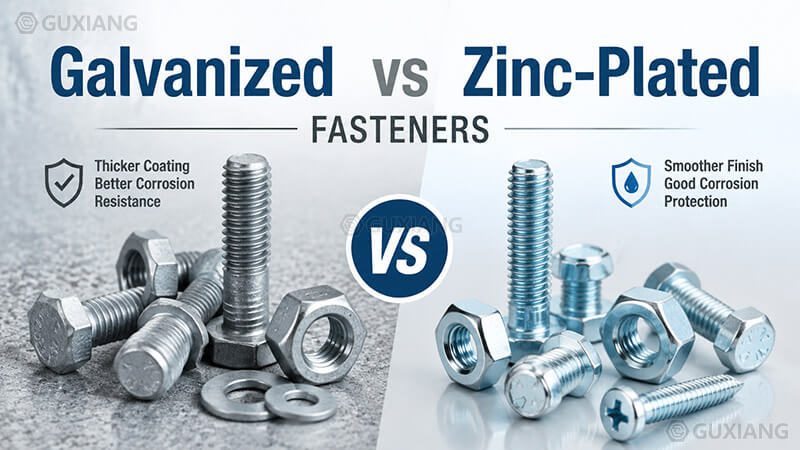
Zinc-plated and galvanized fasteners are not the same product, and mixing them up costs money in the field. Both carry a zinc coating, so the confusion is understandable. But electroplated zinc is a thin, decorative-grade layer measured in microns, while hot-dip galvanizing is a thick, metallurgically bonded armor layer measured in tens of microns. A zinc-plated bolt lasts a season outdoors; a hot-dip galvanized bolt lasts decades. If you are buying fasteners for a fence, a solar rack, a guardrail, a transmission tower, or any outdoor steel structure, this distinction decides how often you replace hardware and what the corrosion warranty actually covers.
This guide is the second entry in our Surface Finishes series, and it sits next to our earlier comparison of stainless steel vs galvanized bolts. That article answered the material question: do you need stainless steel or zinc-coated steel? This one answers the coating question: once you choose zinc, how should the zinc be applied, and what does each application route change about threads, embrittlement, and corrosion life?
First, the Naming Mess
Before any numbers, you need to know how the words are used, because the industry is not consistent.
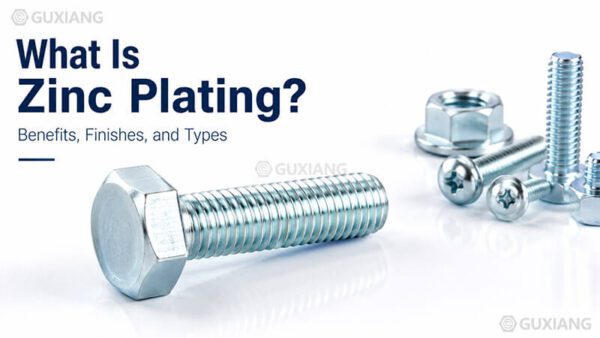
Zinc-plated almost always means electroplating — zinc deposited from an electrolytic bath onto the fastener surface. The coating is thin, smooth, and uniform. In North America this is the default finish on cheap bolts, screws, and nuts sold in hardware stores. It is specified under ASTM B633 or ISO 4042.
Galvanized is the loose word. Strictly, galvanizing means coating steel with zinc by any method. In practice, fastener buyers use “galvanized” to mean hot-dip galvanizing — the part is dipped into molten zinc at about 450°C, and a thick zinc-iron alloy layer forms. In North America, “galvanized” on a fastener drawing almost always means hot-dip, specified under ASTM A153 or ISO 1461.
The trap: in some regions and some catalogs, “galvanized” is used loosely for electroplated zinc. A buyer who orders “galvanized bolts” and receives zinc-plated ones has no legal case unless the drawing named the standard. On every drawing, write the standard, not the word.
There is also a third family you will meet: mechanical galvanizing — zinc powder is peened onto the part in a rotating drum. It sits between the two in thickness, and it exists mainly to avoid hydrogen embrittlement on hardened parts. It shows up less often in fastener work, but it belongs in this conversation because it solves a problem both electroplating and hot-dip share.
The Two Processes: Tank vs Kettle
Electroplating: What Happens in the Tank
The fastener is suspended in an aqueous zinc bath and made the cathode. Zinc anodes dissolve, zinc ions plate out onto the part, and a thin, dense layer builds up. The bath chemistry varies — cyanide, alkaline non-cyanide, and acid chloride are the three families — and each changes throwing power, brightness, and hydrogen generation.
Plating time is minutes, not hours. The coating grows uniformly on every surface, including thread roots and internal recesses, which is why plated threads stay in tolerance. Brighteners in the bath give the shiny, slightly blue-tinted finish you see on store-bought screws. That shine is cosmetic; it says nothing about corrosion life.
Hot-Dip Galvanizing: What Happens in the Kettle
The route is completely different. The fastener is first cleaned — caustic degreasing, then acid pickling to strip mill scale and rust — then dipped in flux to keep the surface active, then immersed in a bath of molten zinc held near 450°C. The zinc wets the steel and reacts with it, forming a series of zinc-iron intermetallic layers, with a pure zinc outer layer on top.
The metallurgical bond is the key difference. Electroplated zinc sits on the surface and can be scratched off. Hot-dip zinc is alloyed into the steel surface; it does not peel. A heavy hammer blow can crack it, but normal handling does not remove it.
Hot-dip coating thickness is set mostly by steel chemistry and bath temperature. Silicon and phosphorus in the steel drive the reaction — the so-called Sandelin effect — which is why the same galvanizing line can produce a 60 µm coating on one bolt and a 110 µm coating on another bolt from the same box. This variability is normal and it is exactly why threaded fasteners cause trouble, as Section 5 explains. For a broader background on the process and its metallurgy, the Wikipedia article on hot-dip galvanization covers the layer structure in detail.
The One-Sentence Version
Electroplating lays a thin, uniform zinc skin on the part. Hot-dip galvanizing grows a thick zinc-iron armor that is part of the part. Everything else — thread fit, corrosion life, embrittlement risk, cost — follows from that difference.
Standards: ASTM vs ISO, and Which One You Are Actually Buying
The standard named on the drawing is the real specification. The words “zinc plated” or “galvanized” are not. Three pairs of standards cover nearly all fastener work, and a surprising number of failures trace back to a drawing that named none of them.
| Finish | North America | International | What It Covers |
|---|---|---|---|
| Electroplated zinc | ASTM B633 | ISO 4042 | Zinc electroplating on iron and steel, thickness classes, supplementary finishes, embrittlement relief |
| Hot-dip galvanizing, hardware | ASTM A153/A153M | ISO 1461 | Hot-dip zinc coatings on iron and steel articles, coating weight/class, sampling and test methods |
| Salt spray testing | ASTM B117 | ISO 9227 | Neutral salt spray test method used to qualify coatings |
ASTM B633 divides electroplated zinc into four thickness classes, FE/Zn 5, 8, 12, and 25 — the number is the minimum coating thickness in microns. It also defines five types of supplementary finishes, from plain (Type I) through chromate conversion to passivation. A drawing that says “zinc plated, clear chromate” without a class is telling the plater nothing; the plater will ship whatever is cheapest. Write FE/Zn 12 or FE/Zn 25 and the conversation changes.
ASTM A153 covers hot-dip galvanizing of iron and steel hardware — the fastener class of parts — and grades coatings by class and coating weight in ounces per square foot. Fasteners under A153 typically receive Class B or C coatings; the standard is the workhorse for hot-dip fasteners in North American construction.
ISO 1461 is the international hot-dip standard, and it specifies coating thickness by steel section thickness. For a typical bolt shank or nut, the required average thickness lands in the 45–85 µm range depending on steel thickness. That is the number to remember: hot-dip zinc on a fastener is roughly five to ten times thicker than electroplated zinc. The current edition is ISO 1461:2022, which explicitly notes that fasteners with their own dedicated standards may be covered elsewhere — and that “elsewhere” is ISO 4042 for the plated route.
ISO 4042 covers electroplated coating systems for steel fasteners specifically. It is the fastener-grade counterpart to ASTM B633, and it is the standard that matters when you care about hydrogen embrittlement, because it ties coating thickness, baking, and hydrogen relief into one system. The current edition, ISO 4042:2022, is the reference for plated fastener specs in most export work.
The practical rule for exporters: if your customer is in North America, name ASTM B633 for plated and ASTM A153 for hot-dip. If your customer is in Europe, name ISO 4042 and ISO 1461. Name both where the part crosses both markets — it costs one line on the drawing and removes a whole class of disputes.
4. The Thickness Ledger: 5–15 µm vs 45–85 µm
Thickness is the single number that explains almost everything else. Put the two coatings side by side:
| Property | Zinc-Plated (Electroplated) | Hot-Dip Galvanized |
|---|---|---|
| Typical coating thickness | 5–15 µm (FE/Zn 5–25 per ASTM B633) | 45–85 µm typical on fastener sections (ISO 1461) |
| Coating weight | 35–110 g/m² | 320–610 g/m² |
| Bond | Mechanical/electrochemical deposition | Metallurgical zinc-iron alloy layers |
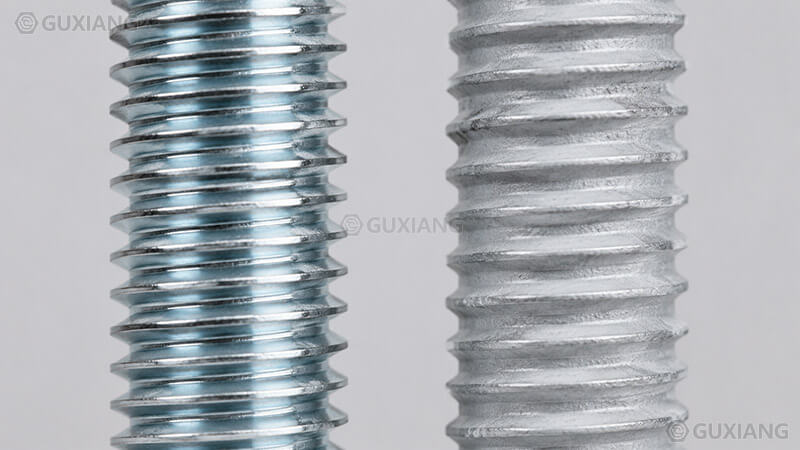
| Surface | Smooth, bright, uniform | Matte, textured, variable, drips on heavy parts |
| Edge coverage | Good, follows contours | Can be thin on sharp edges, thick on flats |
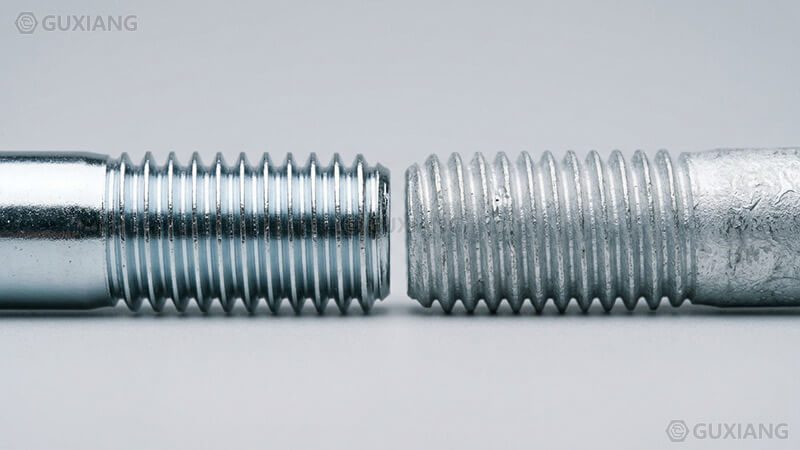
| Threads | Coating follows thread profile | Coating can bridge or fill thread roots |
| Sacrificial life in same environment | Measured in months to a few years | Measured in decades |
The zinc protects steel sacrificially: zinc corrodes first, the steel stays intact, and the corrosion rate of zinc in a given atmosphere is roughly constant. So coating life scales almost linearly with coating thickness. A 10 µm plated coating and a 70 µm hot-dip coating in the same atmosphere have about a seven-fold difference in life before the steel starts rusting. That is the whole economics of the decision, compressed into one row of a table.
Do not read thickness alone, though. Hot-dip coatings on fasteners are not uniform. Sharp edges — thread crests, wrench flats — can run thin, while flats run thick. A plated coating is far more uniform across the part. For corrosion life, the average matters; for thread fit, the thickest points matter, and that is the next section.
Thread Tolerance: Why Hot-Dip Eats the Thread
This is the failure mode that generates the most angry phone calls. A hot-dip galvanized bolt will not fit its nut, and the buyer blames the supplier, and the supplier blames the standard, and the real answer is that nobody accounted for coating thickness on the thread.
Here is the geometry. On an external thread, the coating grows outward and the pitch diameter grows. A 60–85 µm hot-dip coating on a bolt adds roughly that much to the pitch diameter — in the worst case, more, because coating builds up in thread roots and crests unevenly. On an M12 bolt with a standard 6g tolerance, a hot-dip coating can push the pitch diameter outside the acceptable range. The nut threads on halfway and jams, or the assembler forces it and strips the thread, or the nut gets cross-threaded under torque.
Zinc-plated fasteners do not have this problem because 5–15 µm sits comfortably inside standard thread tolerances. This is the most common reason specifiers choose plated fasteners even in corrosive service: it is not that they love plating, it is that the threads work.
The industry has a standard answer for hot-dip: oversize the thread before galvanizing. ASTM A153 and ISO 1461 both address this — hot-dip galvanized bolts are commonly tapped or rolled oversize (the familiar “oversize nut” or “galvanized after threading with oversize allowance”) so the coating brings the final pitch diameter back into fit. In practice:
Roll or cut the thread oversize by the expected coating build, typically 0.25–0.4 mm on pitch diameter for M10–M20 bolts.
Tap the nut oversize to match, or use a nut tapped after galvanizing.
Always test-fit with a functional thread gauge and an actual nut from the same batch before shipping.
The lesson from the shop floor: never buy hot-dip galvanized fasteners from a supplier who cannot tell you their oversize threading practice. If they say “we just dip standard bolts,” the threads will fail, and the failure will be blamed on you, the specifier.
Hydrogen Embrittlement: The Quiet Killer
Hydrogen embrittlement is the fastener failure that kills people, and it is tied directly to the coating process.
The mechanism, in one paragraph. During acid pickling and electroplating, atomic hydrogen is generated at the steel surface. In hardened steel — typically above about 1000 MPa tensile strength — hydrogen atoms diffuse into the lattice and collect at stress concentrators. After assembly, the hydrogen migrates to high-stress points, and the bolt fails suddenly, often hours or days after installation, at a fraction of its rated load. The bolt snaps. There is no warning, no yielding, no visible corrosion. In overhead lifting, fall protection, and structural connections, this is a catastrophic failure mode.
Electroplating is the high-risk route because the bath itself generates hydrogen at the cathode — that is the plating process. Hot-dip galvanizing also exposes the part to hydrogen during pickling, but the 450°C molten zinc bath acts as a natural bake, driving hydrogen out. So in practice, hot-dip carries far lower embrittlement risk than electroplating on the same steel grade.
The control for electroplating is a post-plate bake. ISO 4042 and ASTM B633 both require hydrogen embrittlement relief baking for hardened parts: typically 190–230°C for 4–24 hours, started within one hour of plating. The bake is only effective if it happens soon after plating and before any subsequent coating steps seal the surface.
The practical rules:
Do not electroplate fasteners above roughly 1000–1200 MPa (grade 10.9, grade 8.8 borderline, most quenched-and-tempered alloy steel) without a documented bake cycle. The alloy steel fasteners guide covers the strength grades in detail.
Grade 12.9 and above: electroplating is generally off the table. Use mechanical galvanizing, zinc flake coating, hot-dip with controlled processing, or a corrosion-resistant alloy.
Ask the plater for the bake certificate, not the promise. A bake that did not happen cannot be detected on the finished part, so the paper trail is the only evidence.
If the joint is safety-critical — lifting, suspension, structural — treat “zinc plated, grade 10.9” as a red flag until you see the process certificate.
Hydrogen embrittlement does not show up in corrosion testing. A bolt can pass salt spray and still be time-bombed. That is why the process control matters more than the coating test.
White Rust vs Red Rust: Reading the Failure
Both coatings fail in predictable ways, and the color of the corrosion product tells you which stage you are in.
White rust is the first sign of trouble on fresh zinc. When a zinc surface gets wet and dries repeatedly without a chance to form its protective patina — think stacked parts in rain, or condensation in transit — it forms bulky white zinc hydroxide and zinc oxide. White rust is not the coating gone; it is the surface reacting. On hot-dip coatings, white rust is mostly cosmetic and the residual zinc still protects for years. On thin plated coatings, white rust is more serious, because 10 µm of zinc consumed by white rust is a large fraction of the coating.
Prevention: keep parts dry in storage and transit, keep packaging ventilated, and avoid tightly nested wet parts. Chromate or passivation treatments on plated parts delay white rust onset. On galvanized parts, the industry uses quench treatments and silicate or chromate passivation for the same reason.
Red rust means the zinc is gone — locally or entirely — and the steel is corroding. Red rust on a plated fastener appears first at thread crests, edges, and damaged spots, because that is where the thin coating is thin or broken. Red rust on a hot-dip part is usually edge-driven too, or the sign of coating damage from spanner jaws, impact, or scratches that cut through to steel.
The practical read: white rust on galvanized is a storage complaint, not a failure. Red rust on either coating is a real failure that means the coating budget was exceeded or the wrong coating was chosen. When a customer sends a photo of red rust on a plated bolt after one winter, the answer is not “better plating,” it is “hot-dip or stainless,” and the cost conversation follows.
Salt Spray and Real Corrosion Life
Salt spray testing (ASTM B117 or ISO 9227 neutral salt fog) is how most coating specs are verified, and it gets misread more than any other test in this industry.
Typical results for fasteners, using representative values from plating and galvanizing practice:
| Coating | Typical B117 Neutral Salt Spray Before Red Rust | Read It As |
|---|---|---|
| Zinc plated, 5–8 µm, clear passivate | 24–72 h | The absolute bottom of the market |
| Zinc plated, 8–12 µm, yellow/olive chromate | 72–120 h | Common hardware-store grade |
| Zinc plated, 12–25 µm, trivalent passivate | 120–250 h | Good plated work, but still thin |
| Hot-dip galvanized, 45–85 µm | 1000–2000+ h | A different corrosion class entirely |
| Hot-dip galvanized, heavy sections | 2000–3000+ h | Thick coatings, long life |
Three honest warnings about these numbers. First, salt spray is an accelerated test with a high chloride load; it correlates with marine and road-salt exposure but overstates the difference in mild indoor atmospheres. Second, salt spray does not test sacrificial life in the same way real service does — real life involves wet-dry cycling, UV, and abrasion, and zinc behaves differently. Third, salt spray tells you nothing about hydrogen embrittlement, thread fit, or galvanic compatibility. It is one number in a qualification, not the whole story.
The field number that actually matters: in a typical industrial atmosphere, zinc corrodes at roughly 1–4 µm per year, and in a marine atmosphere 3–10 µm per year, depending on the exposure. Do the arithmetic yourself — a 10 µm plated coating in a marine environment is a one-to-three-year proposition, and a 70 µm hot-dip coating is a ten-to-twenty-year proposition. That gap is why infrastructure fasteners are hot-dip or stainless, and why indoor hardware is plated.
Galvanic Compatibility: Zinc Is Not a Universal Answer
Zinc is anodic to steel, which is the entire point of the coating. But zinc is also anodic to most other common metals, and that creates compatibility problems when zinc-coated fasteners meet other materials.
The classic case is **zinc fasteners on aluminum.** Zinc is anodic to aluminum, so the zinc corrodes preferentially — in principle, the aluminum is protected. In practice, the zinc coating on a small fastener is thin and gets consumed fast, the aluminum around the head corrodes anyway from the galvanic couple, and the joint fails in an unpredictable way. For aluminum structures, stainless steel fasteners are the standard answer for a reason; if zinc is used at all, it is a temporary or non-structural choice. Where the aluminum part itself needs a finish, anodizing is the aluminum-specific route — different chemistry, different coating, different rules, covered in the **[anodizing fasteners guide](/blog/anodizing-fasteners-guide/)**.
**Zinc fasteners with stainless steel** are the reverse and worse. Stainless is cathodic to zinc, so the zinc is consumed rapidly as the anode, and the stainless hardware acts as a large cathode driving fast attack on the small zinc coating. A plated bolt in a stainless bracket is a fast-corrosion setup, not a corrosion solution. If the structure is stainless, use stainless fasteners — the material comparison is argued out in our stainless versus galvanized article.
**Zinc with copper and brass** is also a mismatch: zinc is anodic to copper alloys, and brass fasteners are chosen in copper systems for metallurgical consistency, as the **[brass fasteners guide](/blog/brass-fasteners-guide/)** explains. Mixing zinc-coated steel into a copper plumbing or electrical system trades one corrosion problem for another.
The rule: zinc coatings belong on steel structures with steel or other zinc-compatible fasteners, in environments where the sacrificial life is sufficient. The moment the mating metal is aluminum, stainless, or copper alloy, stop and reconsider the material choice, not the coating.
Four Field Complaints and What They Cost
Real customers do not call to complain about coating thickness classes. They call with four stories, and each one traces to a process decision.
“The bolts rusted after one winter.” The classic plated-fastener complaint. The part was probably FE/Zn 5 or 8 with clear passivation, sold for outdoor use, and the coating was consumed in a single wet season. Fix: either upgrade to FE/Zn 12–25 with a proper passivate, or move to hot-dip for anything load-bearing outdoors. Also check storage — white rust in the box often precedes red rust in the field.
“The nut will not go on the galvanized bolt.” Thread tolerance failure from Section 5. The supplier dipped standard threads and the coating bridged them. Fix: require oversize threading before galvanizing, test-fit with a nut from the same batch, and write the allowance into the purchase order. This is the complaint that turns a cheap galvanized purchase into a site delay, and the delay costs more than the fasteners.
“The high-strength bolts snapped after installation.” Hydrogen embrittlement, Section 6. A grade 10.9 or 12.9 plated bolt that was not baked, or baked without documentation. Fix: no plating above the strength threshold without a certified bake, mechanical galvanizing or zinc flake for the hardest grades, and a process certificate on every lot. Nothing else in this guide kills people; this is the one.
“The white powder on the galvanized parts — is it rust?” White rust panic. Mostly a storage and transit issue, cosmetic on hot-dip, serious only on thin plated coatings. Fix: keep parts dry, explain the difference to the customer, and on thin plated work, spec a passivate. One photo and one honest explanation usually settles this complaint without a return.
Each of these complaints has a fix that costs less than the complaint. The pattern across all four: the failure was decided at specification time, not at the factory.
North American vs European Practice
Exporters meet the difference constantly. The two markets specify zinc coatings differently, and a part approved in one is not automatically approved in the other.
| Topic | North America | Europe |
|---|---|---|
| Plated zinc standard | ASTM B633 (classes FE/Zn 5–25) | ISO 4042 (coating systems, embrittlement controls) |
| Hot-dip standard | ASTM A153/A153M (hardware classes) | ISO 1461 (thickness by section) |
| Salt spray test | ASTM B117 | ISO 9227 |
| Common plated grade | FE/Zn 5 clear, very common in hardware | Fe/Zn 5–12 with Cr⁶⁺-free passivation; REACH pushes trivalent |
| Hexavalent chromate | Still used, RoHS-restricted in products | Effectively banned for most applications under REACH |
| Hot-dip fastener practice | Oversize threading common, Class C coatings | ISO 1461 thickness tables, oversize threading common |
| Coating thickness units | µm and mils, coating weight oz/ft² | µm, g/m² |
The regulatory pressure is the part that surprises exporters. Hexavalent chromium passivates — the yellow and olive finishes that dominated plated fastener corrosion performance for decades — are under heavy restriction in Europe under REACH, and trivalent (Cr³⁺) passivates are now the default. Cr³⁺ passivates perform differently: less self-healing, different corrosion behavior, and lower salt spray hours in some formulations. A fastener spec written in 2010 that says “zinc plated, yellow chromate” is not buildable in Europe today without a reformulation conversation.
For hot-dip work, the differences are smaller — both markets rely on the same metallurgy — but the thickness expectations differ. A European drawing cites ISO 1461 and gets 45–85 µm by section thickness. A North American drawing cites A153 and gets coating weight classes. Write both on the drawing for dual-market parts, and you eliminate the most common export dispute: “our standard says this is adequate.”
Selection Framework
Four questions settle nearly every galvanized-vs-plated fastener decision. Walk them in order.
Step 1: Where Does the Fastener Live?
Indoor, dry, sheltered — plated zinc is almost always sufficient, and for fully non-corrosive or non-metallic needs the plastic fasteners guide covers when polymer hardware makes sense. Outdoor, wet, coastal, road-salt, chemical — the coating thickness ledger decides: plated zinc is a few-year finish, hot-dip is a multi-decade finish. If the structure is designed for 25 years, the fasteners need a 25-year finish.
Step 2: What Is the Strength Grade?
Below about 1000 MPa, electroplating is routine. Above it, hydrogen embrittlement management dominates the decision — certified bake, mechanical galvanizing, or zinc flake. Above about 1200 MPa, electroplating is generally out. High-strength work also changes the material conversation entirely, and the carbon steel fasteners guide covers the grade landscape.
Step 3: Can the Thread Fit Absorb the Coating?
Plated coatings fit standard threads. Hot-dip needs oversize threading, oversize or re-tapped nuts, and a functional test-fit. If the joint is tight-tolerance, fine-pitch, or assembled blind, the hot-dip thread problem may outweigh its corrosion advantage — this is where some specifiers choose stainless or plated zinc with a shorter life rather than fight the fit.
Step 4: What Does the Drawing Actually Say?
Name the standard, the class, the passivation, the bake requirement, and the test method. “Galvanized” or “zinc plated” without a standard is a conversation, not a specification. The drawing is where this guide’s lessons get enforced — write the ISO or ASTM reference, the thickness class, and the embrittlement relief, and the supplier has no room to ship the cheapest version of the word.
Worked Example: Railing Hardware for a Coastal Boardwalk
The fasteners hold stainless railing to a steel structure on a salt-air boardwalk. Step 1: coastal, salt, decades — thin plating is out. Step 2: the structural bolts are grade 8.8, so electroplating is possible with baking but marginal; the coating life is the bigger problem. Step 3: M16 bolts, coarse thread, room for oversize threading. Step 4: the spec reads “hot-dip galvanized per ISO 1461, oversize threaded before galvanizing, test-fit with nut from same batch, coating thickness 70 µm average, 55 µm minimum.” The fasteners cost more than plated ones and last twenty times longer. The boardwalk does not get re-bolted every three years.
Frequently Asked Questions
1. What is the difference between galvanized and zinc-plated fasteners?
Zinc-plated fasteners get a thin electroplated zinc layer, typically 5–15 µm. Galvanized fasteners are hot-dip coated in molten zinc, typically 45–85 µm, with a metallurgical bond.
2. Is galvanized or zinc-plated better for outdoor use?
Hot-dip galvanized. The thicker coating gives roughly ten times the sacrificial life in the same atmosphere. Zinc plating suits indoor and sheltered service.
3. Do galvanized bolts fit standard nuts?
Not reliably. Hot-dip coating builds up on threads, so bolts need oversize threading and nuts need matching oversize threads or re-tapping after galvanizing.
4. Can zinc-plated fasteners be used on stainless steel?
No. Stainless is cathodic to zinc, so the zinc coating corrodes rapidly as the anode. Use stainless fasteners on stainless structures.
5. What causes white rust on galvanized fasteners?
Fresh zinc reacting with moisture before a protective patina forms. It is mostly cosmetic on hot-dip coatings but consumes significant thickness on thin plated coatings.
6. Do zinc-plated bolts need hydrogen embrittlement relief?
Above about 1000 MPa, yes. Hardened fasteners need a post-plate bake at 190–230°C within one hour of plating, with documented process certificates.
7. What coating thickness do zinc-plated fasteners have?
ASTM B633 classes run FE/Zn 5, 8, 12, and 25 — minimum thickness in microns. Common hardware-store plating is FE/Zn 5–8; durable work uses 12–25.
8. Are galvanized fasteners compatible with aluminum?
Poorly. Zinc is anodic to aluminum and corrodes preferentially, consuming the coating fast. Stainless fasteners are the standard choice for aluminum structures.
9. How long does galvanized coating last in salt spray?
Representative B117 results run 1000–2000+ hours for hot-dip coatings versus 24–250 hours for plated coatings, depending on thickness and passivation.
10. Can you paint over galvanized or zinc-plated fasteners?
Yes, but preparation matters. Zinc surfaces need cleaning and often a specific primer; painting over fresh zinc without preparation fails by adhesion loss. Hot-dip surfaces may need weathering or sweep blasting first.
References
International Organization for Standardization. “ISO 1461:2022 — Hot dip galvanized coatings on fabricated iron and steel articles — Specifications and test methods.” https://www.iso.org/standard/81435.html
International Organization for Standardization. “ISO 4042:2022 — Fasteners — Electroplated coating systems.” https://www.iso.org/standard/77913.html
ASTM International. “ASTM B633-15 — Standard Specification for Electrodeposited Coatings of Zinc on Iron and Steel.” https://www.astm.org/b0633-15.html
ASTM International. “ASTM A153/A153M-16 — Standard Specification for Zinc Coating (Hot-Dip) on Iron and Steel Hardware.” https://www.astm.org/a0153_a0153m-16.html
American Galvanizers Association. “Galvanizing Education and Resources.” https://galvanizeit.org/
Wikipedia. “Hot-dip galvanization.” https://en.wikipedia.org/wiki/Hot-dip_galvanization
ASTM International. “ASTM B117-19 — Standard Practice for Operating Salt Spray (Fog) Apparatus.” https://www.astm.org/b0117-19.html